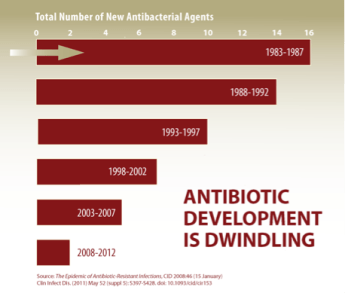
Total number of new antibiotics approved by the FDA over 3 decades. Antibiotic development rates have been steadily decreasing, as novel antibiotic classes become increasingly difficult to discover, and pharmaceutical companies are finding other more lucrative areas of research to focus on.
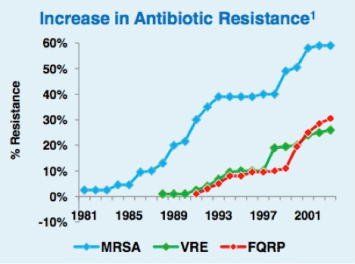
Several bacteria have become resistant to certain potent antibiotics over last couple of decades. MRSA (Methicillin-resistant S. aureus) resistance rates have increased by almost 60% in 2001. Other bacteria such as VRE (Vancomycin-resistant Enterococci) and FQRP (Fluoroquinolone-resistant Pseudomonas Aeruginosa) have also increased resistance rates of about 30% over a decade.
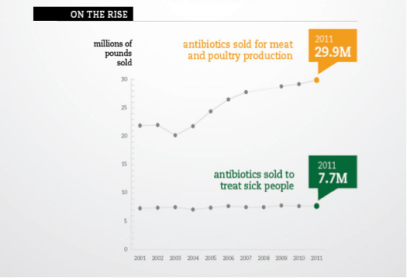
This graph shows a comparison of antibiotic use trends in humans and in livestock. It is quite clear that antibiotics sold for meat and poultry production far exceeds antibiotics sold to patients who actually need it.
Learn more about antibiotic resistance in our Articles section.
References:
-
CDC. Antibiotic Development is Dwindling. 2016. Available from: http://www.cdc.gov/getsmart/community/materials-references/graphics.html
-
Centers for Disease Control and Prevention [Internet]. 2014 [cited 15 November 2016]. Available from: http://news.asiantown.net/r/41254/antibiotic-resistant-infections-in-india-could-go-pandemic
-
Pew Charitable Trusts. Record-High Antibiotic Sales for Meat and Poultry Production. 2013. Available from: http://www.pewtrusts.org/en/research-and-analysis/analysis/2013/02/06/recordhigh-antibiotic-sales-for-meat-and-poultry-production
 Antibiotic Resistance